DealCraft
An incomplete advertiser brief becomes a priced sales file where every figure points back to its source.
See it live ↗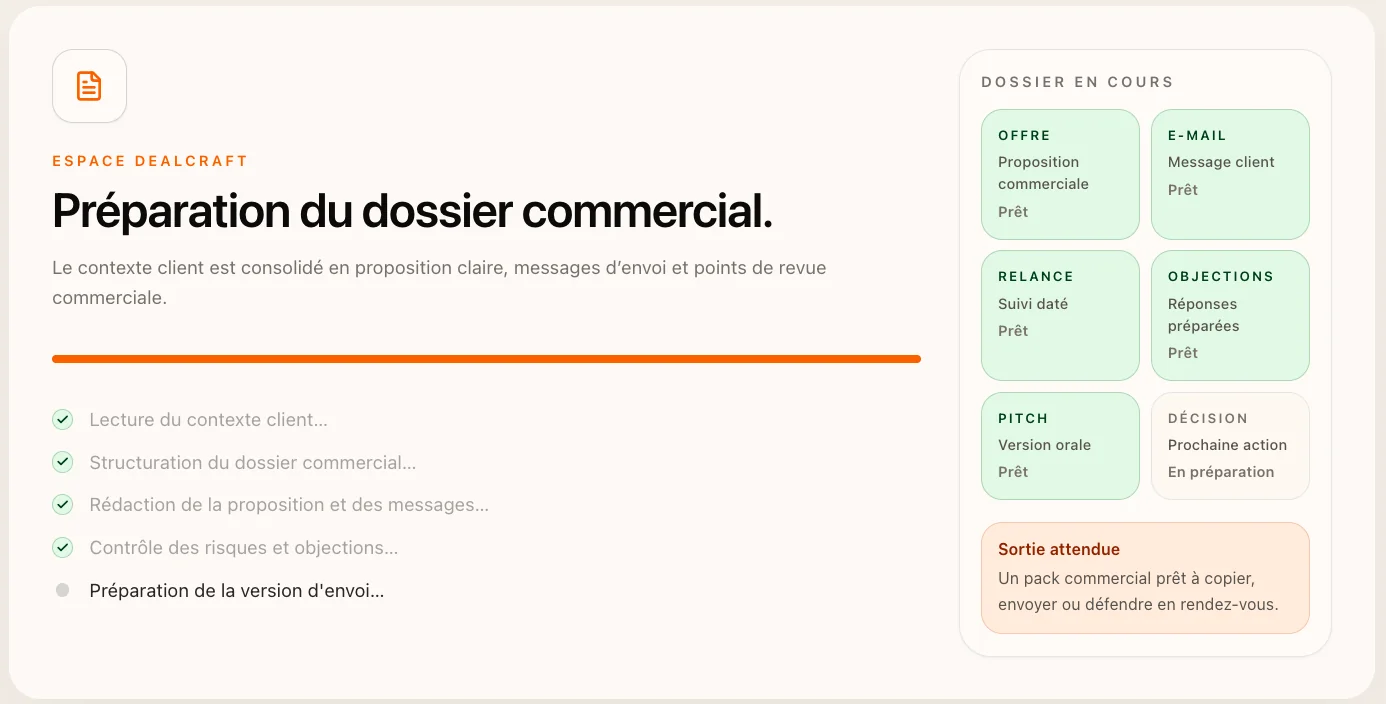
Context
A salesperson answers fast, under pressure, and the nuance of the client’s situation slips away. I’ve lived that moment hundreds of times.
Advertising sales adds a difficulty of its own: you have to quote a price. And a price you put in front of an advertiser has to be defensible, with a source.
From brief to file
DealCraft takes whatever a salesperson has on hand walking out of a meeting, an email, some notes, an incomplete brief, and turns it into an advertiser file: media recommendation, ready-to-send email, follow-up, answers to objections, a three-minute spoken pitch and a commercial score.
Six deliverables rather than one block of text, because a salesperson does not always open through the same channel. Depending on the client and the moment, it will be the email, the spoken pitch, the priced proposal or the answer to an objection. They hold every card and pick their own.
Quoting with a source
Every priced scenario points back to the published rate card it came from, with a link to the rate page and the date the source was read. The tool does not hand you a price, it hands you a price you can go and check before you say it out loud.
It never presents itself as final either. The file comes out marked as a draft to verify, and states that availability, discounts, surcharges and terms have to be confirmed before anything reaches the client.
Try it now
A sample brief is pre-filled. Swap it for your own context if you like: the generation is real, nothing is scripted.
Follow-up email
Anticipated objections
Next action
This demo is deliberately reduced: the full product also generates the proposal, the follow-up and the pitch. Open the DealCraft app
What it refuses to guess
Before producing anything, DealCraft measures what the brief actually contains and shows what is missing: the budget that will settle the formats, the person who will sign off the recommendation, the objective and the priority audience. The fields it pulled out of the brief are shown one by one, labelled as extracted, so they can be corrected before generation.
A tool that quietly fills the gaps in a brief produces text that is credible and wrong. It is the rule I hold myself to on Velq as well.
Where it stands
I am not trying to sell it. The sales-enablement market is saturated and most tools already do what DealCraft does. What is still distinctive here is tying each scenario to a dated public rate, and that only matters inside a team selling those rates.
So its useful life is internal, inside a media sales house, not online. The prototype stays public because it can be tried in three minutes.
The playable demo on this page is a reduced version written for the site: three deliverables out of the six.
Highlights
- Six deliverables in one pass: media recommendation, email, follow-up, objections, three-minute pitch, commercial score
- Every priced scenario points back to the published rate card it came from, with the date it was read
- The file comes out labelled a draft to verify, with the list of what the brief is still missing
- A public demo written for the site, cut down to three deliverables
The takeawayI am not trying to sell this tool, the market is saturated. What was worth building is its refusal to quote a price without showing where the price comes from.